
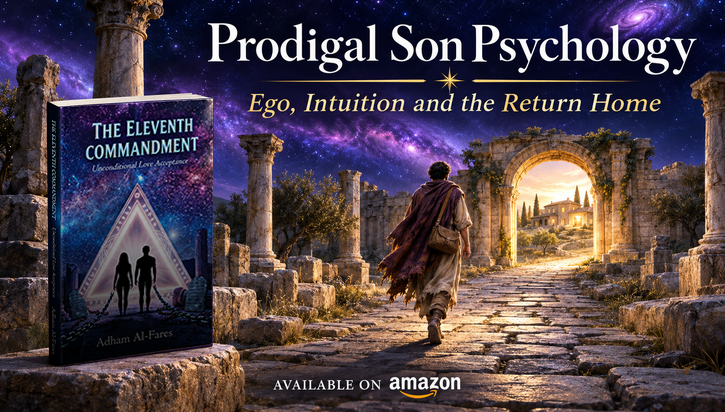

Most of us know the Prodigal Son as a story about forgiveness. A young man leaves, wastes everything, and comes home to a father who welcomes him. But what if the characters in that story are not three different people, but parts of one?
In The Eleventh Commandment, Adham Al-Fares reads the parable exactly that way: as an inner drama between ego, intuition, and soul. This article walks through that reading, what it says about acceptance, and how it differs from the more familiar interpretations.
Quick Answer: The Prodigal Son as an Inner Story
In the book’s reading, the parable maps onto the Trifecta:
- The younger son is the ego, which leaves home to chase validation and squanders everything.
- The father is intuition, which welcomes the ego back without conditions.
- The soul is the bridge that makes the reunion possible.
- The older son is the self-righteous side of the ego, the part that never left home.
Al-Fares’s central point is that the parable is not about punishment or penance but about acceptance. The father did not simply forgive his son. He accepted him. This is one reading among many, offered for reflection rather than as doctrine.
The Parable in Brief
A father has two sons. The younger one asks for his inheritance early, leaves home, and spends it all on reckless living. He hits bottom, working with pigs, starving and desperate. He decides to return home, not as a son but as a servant, ready to accept whatever punishment or terms his father sets.
The father does something unexpected. He does not demand that his son prove himself worthy. He runs to meet him, embraces him, and throws a feast. The older son, who stayed and followed every rule, becomes resentful. The father tells him that everything he has is his, but that they had to celebrate, because his brother was lost and has been found.
The Younger Son: The Ego That Goes Astray
In the Trifecta, the ego is driven by lack, need, and want. It feels it lacks validation, so it needs recognition, so it wants status, achievement and approval. Because outside approval never fills an inner gap, it keeps reaching.
That is the younger son: someone sure that fulfilment is somewhere else, far from home. Al-Fares says the ego’s detour is almost inevitable. It chases money, power and achievement, hits bottom, and only then turns back. Notice that the son does not return in triumph. He returns empty, expecting punishment, which is the ego’s own idea of justice.
For more on what it means to heal rather than destroy this part of ourselves, see ego integration.
The Father: Intuition Welcomes Without Conditions
In the book’s mapping, the father is intuition, which Al-Fares describes as authentic emotional intelligence and the original source of wisdom. What stands out in the story is what the father does not do. He does not say “I told you so.” He does not set terms. He does not make his son earn his way back.
For Al-Fares, that is what intuition does for the ego: it receives it as it is. The ego has spent its life believing it must be punished or must perform to be loved. Intuition simply embraces it.
The Soul: The Bridge That Makes the Reunion Possible
The story never names the soul, but in the book it is the connection that makes the reunion work. Al-Fares describes the soul as the bridge, the authentic essence that links the ego and intuition and can accept both. Without it, the ego and intuition remain two separate voices. With it, they meet.
If you want the full framework behind this, start with the Trifecta.
The Older Brother: The Ego That Never Left Home
The book also pays attention to the older son, who is easy to overlook. He did everything right, stayed home and followed the rules, and he is angry that the “loser” gets a feast. Al-Fares reads him as another face of the ego: the self-righteous part that measures itself by its good behaviour and resents unconditional acceptance.
That gives the parable a second layer. The ego can go astray in two ways: by running wild, or by clinging to being right. Both are driven by the same need for validation, and both are invited home.
Forgiveness vs Acceptance
The most interesting claim in the book’s reading is a distinction. Al-Fares argues that the parable is not about punishment or penance but about acceptance, and that the father did not just forgive, he accepted.
The difference matters. Forgiveness can still leave the other person in debt, someone who was wrong and has now been let off. Acceptance meets the person as they are, with no scorecard. In the book’s terms, acceptance is what lets unconditional love thrive; without it, resistance and friction persist. If you want to explore this idea, read about unconditional acceptance.
Other Readings, and the Trinity Connection
The parable has been read in many ways. Traditional readings see it as a story of repentance and a father’s forgiving love, and psychological readings, including Jungian ones, have linked its characters to ego, shadow, and the Self. Al-Fares offers his own version, and he goes further than most: he maps the Trifecta onto the Christian Trinity, reading the Father as intuition, the Son as ego, and the Holy Spirit as soul.
His argument is that religion described a real psychological structure but placed it “out there” in heaven, when it is inside us. He points to the line that the kingdom of God is within you as support. That is his interpretation, and readers will hold different views on it.
How to Try It: Return Home to Yourself
The book suggests a simple way to apply the parable: talk to your ego, out loud if you are alone or in writing if not. Ask it what it lacks, why it hurts, what it is trying to prove, and what it is afraid of. Then listen without judgment, let intuition answer, and accept what comes up.
Here is how that might look. This example is an illustration written for this article, not an excerpt from the book.
Imagine a venture you were sure of has failed, and you feel you have come home empty-handed. The ego, like the younger son, prepares its own sentence: I will take any punishment. I deserve it. Ask what it is afraid of, and you may hear fear of being seen as a failure. Then ask intuition. It may say something quieter, such as: You are not what happened. You are still welcome. Letting that acceptance in, instead of the ego’s verdict, is the return home.
This is a reflective exercise, not a substitute for therapy or professional support.
If This Reading Changes How You See the Story
If you have always heard the Prodigal Son as a story about someone else, the book invites you to read it as a story about yourself: the part that wandered, the part that stayed and resented, and the part that is still waiting to be welcomed.
The Eleventh Commandment introduces this reading in Chapter 3, returns to it in Chapter 11 as part of what Al-Fares calls the Trifecta as the true Trinity, and turns the practice of talking to your ego into a structured 30-day Practice Guide.
If you are curious what changes when the ego is welcomed home instead of punished, that is the question the book sets out to answer.
Explore The Eleventh Commandment by Adham Al-Fares
Frequently Asked Questions
What Is the Psychological Meaning of the Prodigal Son?
In The Eleventh Commandment, the parable is read as an inner drama: the ego goes astray chasing validation, intuition welcomes it back without conditions, and the soul bridges the two.
Who Represents the Ego in the Prodigal Son?
The younger son, who leaves home to prove himself and squanders everything. The older son is read as the self-righteous side of the ego that never left.
Who Is the Father in This Reading?
Intuition, which the book describes as authentic emotional intelligence and the original source of wisdom.
What Role Does the Soul Play?
The soul is the bridge that connects ego and intuition and makes the reunion possible.
Why Does the Book Say Acceptance, Not Forgiveness?
Al-Fares argues that the father did not just forgive his son but accepted him, and that acceptance, rather than punishment or penance, is what allows unconditional love to work.
Is This a Religious or a Psychological Reading?
It is both and neither entirely. It is a philosophical interpretation that uses the parable to illustrate a psychological framework. It is not a statement of religious doctrine.
How Does the Prodigal Son Connect to the Trinity in the Book?
Al-Fares reads the Father as intuition, the Son as ego, and the Holy Spirit as soul, and argues the Trinity describes a structure inside us. It is his interpretation, offered for reflection.
How Can I Apply This in Daily Life?
The book suggests talking to your ego: ask what it lacks, why it hurts, what it is trying to prove, and what it fears, then listen without judgment and invite intuition to respond.