
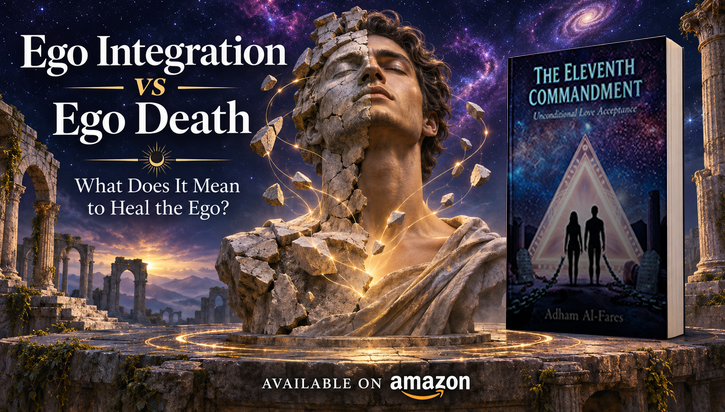

Ask for advice about the ego and you will hear three things. Spiritual teachers say to transcend it. Self-help books say to befriend it. And a growing number of people talk about “ego death,” as if the ego were something to be switched off.
They cannot all be right, and the words are often used loosely. In The Eleventh Commandment, Adham Al-Fares takes a clear position. He argues the ego should be neither killed, suppressed nor merely befriended, but healed and integrated. He also uses the phrase ego death, in a specific way that is easy to misread.
This article explains ego integration, ego death, and how the book connects the two.
Quick Answer: Ego Integration vs Ego Death
Ego integration is the process of healing the ego and connecting it to intuition, so that it stops running on lack and becomes a healthy, functional part of the whole self.
Ego death, in Al-Fares’s usage, is not the destruction of the ego. It is the death of the ego’s dominance: the false identity that controls everything, so that the soul can emerge.
In the book the two are not rivals. Integration describes the lasting structure, with ego, intuition and soul in balance. Ego death describes the moment, and the daily choice, in which the ego stops ruling. This is a philosophical framework offered for reflection, not a clinical model, and other writers use these terms differently.
What Is Ego Integration?
The general idea
In depth psychology, ego integration usually refers to bringing disconnected parts of the personality into a more conscious, coherent relationship with each other. The emphasis is on wholeness rather than elimination.
The book’s version: healed, not killed
Al-Fares makes a sharper claim. In The Eleventh Commandment, the ego brings consciousness, thought and the ability to plan, and it helps you navigate the world and set boundaries. The problem is not that you have an ego. The problem is that it has become disconnected from intuition and operates from lack, need and want.
He also rejects the idea of “befriending” the ego. In his view, befriending implies two separate parties being polite to each other, which he calls ego validation dressed in spiritual language. Integration, by contrast, means seeing the ego’s wounds and limits clearly, accepting it unconditionally, and connecting it to intuition’s truth. The ego then does not disappear. It heals.
The result, he says, is a state he calls lackless, needless and egoless: free from the ego’s tyranny even though the ego remains as a functional part of you. If this framework is new to you, start with the Trifecta.
What Is Ego Death?
How the term is usually used
Elsewhere, “ego death” often describes a temporary loss of your usual sense of self, and it is most often discussed in connection with meditation and psychedelics. The term is contested and used in many ways.
How the book uses it
Al-Fares uses the idea more narrowly. For him, ego death is not the death of the ego entirely, but the death of its dominance and false identity. When that dominance ends, the soul has room to emerge: the authentic self that existed before the ego’s false identity took over. He calls this rebirth, and describes it not as creating something new but as returning to what was always there.
He also treats it as something that is not a one-time event. He calls it a “miniature death” that can happen daily, every time you choose soul over ego, feeling over thinking, and unconditional love over conditional need. He describes a personal experience of ego death in Chapter 10 of the book.
Ego Integration vs Ego Death: The Key Differences
| Ego integration | Ego death (in the book) | |
| What happens to the ego | It is healed and connected to intuition | It stops dominating; it does not disappear |
| What it describes | The lasting structure of a balanced Trifecta | The moment or choice when the ego lets go of control |
| Pace | A process that deepens with practice | Recurring, even daily |
| Common misunderstanding | That it means befriending the ego | That it means destroying the ego |
Why Destroying the Ego Does Not Work
The book’s argument against destroying the ego is practical. If the ego is also what lets you plan, decide and protect yourself, then suppressing it is both impossible and unwise. Al-Fares applies the same logic to history: he argues that rules, religion and fear tried to control the ego from the outside, and that this is why they kept failing. His alternative is to heal the ego from within.
That healing happens through acceptance. Not through approval, and not through ignoring harm, but through seeing the ego’s lack clearly and meeting it without conditions. For more on this, read about unconditional acceptance.
How to Practise Ego Integration
The book’s Practice Guide treats integration as a 30-day practice, and its final stage (Days 22 to 30) focuses on balancing all three parts with unconditional love. Its stated goals are to recognise the ego without fighting it, to honour intuition without intellectualising it, and to return to the soul through acceptance.
One of the Guide’s real-world scenarios shows how this works. It describes a situation in which your partner criticises you. The scenario comes from the Guide and is summarised here.
The ego responds
The ego hears an attack and wants to defend itself or hit back.
Intuition notices
Intuition senses that something deeper is going on.
The soul reframes
The soul sees that the person you love is hurting and asks how you can respond with love.
Notice what does not happen. The ego is not silenced or shamed. It is heard, recognised and then no longer allowed to run the response. That is integration in practice, and, in the book’s terms, a small daily ego death: the moment its dominance gives way.
These are reflective exercises, not a substitute for therapy or professional support.
If You Have Been Asking What to Do With Your Ego
If you have been told to destroy your ego, or to befriend it, and neither has felt right, the book’s third option may be worth a closer look: heal it, and let it work with intuition instead of against it.
The Eleventh Commandment develops this across several chapters. Chapter 3 sets out why the ego is healed rather than killed or befriended, Chapter 10 explores what Al-Fares calls the miniature death of the ego, and the Trifecta Practice Guide turns it into a daily practice.
If you are curious what a healed ego might look like in your own life, that is the question the book sets out to answer.
Explore The Eleventh Commandment by Adham Al-Fares
Frequently Asked Questions
What is ego integration?
In general psychology, it means bringing disconnected parts of the personality into a coherent whole. In The Eleventh Commandment, it means healing the ego and connecting it with intuition so it no longer operates from lack.
What is ego death?
The term is used in many ways. In the book it means the death of the ego’s dominance and false identity, not the death of the ego itself.
What is the difference between ego integration and ego death?
In the book, integration is the lasting balance between ego, intuition and soul, while ego death is the moment or daily choice when the ego stops ruling.
Does the book say you should get rid of the ego?
No. It says the ego is not killed, not suppressed and not merely befriended, but healed and integrated.
Why does the book reject “befriending” the ego?
Al-Fares argues that befriending treats the ego as a separate party to be polite to, which he sees as ego validation in spiritual language rather than real integration.
What does “egoless” mean in the book?
Free from the ego’s tyranny, even though the ego still exists as a functional part of you.
Is ego death a one-time event?
In the book, no. Al-Fares describes it as a “miniature death” that can recur daily, whenever you choose soul over ego.
Is this a psychological or a spiritual idea?
It sits between the two. It is a philosophical framework that draws on both and is not a clinical or therapeutic method.